


I was inspired to write this Substack, in the midst of my revisions, by the following Note (thanks to the great Lincoln Michel for getting this on my feed!):
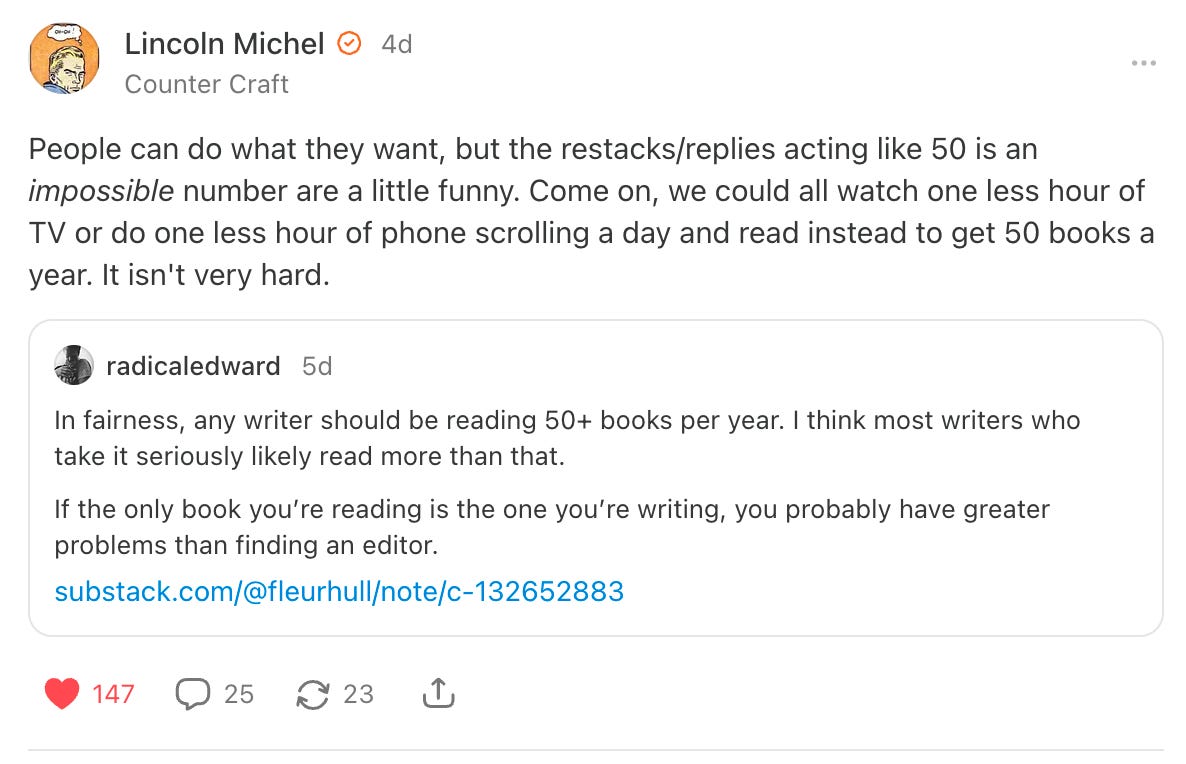
Well, I am here to say: you don’t have to read fifty books a year! I don’t!
But I am also here to say: I do get pretty close. It’s not an impossible number, as Lincoln says. In fact, in the past six years, which included drafting my manuscript and getting my agent and selling my novel, I read: 43 books in 2024, 59 books in 2023, 44 books in 2022, 29 books in 2021, 43 books in 2020, 34 books in 2019, and 24 books in 2018.
I don’t raise these numbers to brag. Many of my friends read way more books each year, and their Goodreads and Storygraphs dwarf mine. But I wanted to write this post because reading is probably the number-one deciding factor that allowed me to draft a manuscript that I felt was good enough to query, and the number-one factor that allowed me to put together some decent comp titles. I wanted to write a little about those books that helped me to get there.
(Plus, scroll down for my ten unconventional tips to read more.)
How I found my comp titles
I often see posts floating around asking, How do you find comp titles?1 Unfortunately, I think there’s only one way to find good ones: reading.
Reading, I think, is naturally a generative act. You read one book that feels on-point and you look up the author. You find they’ve written other books, so you read those. You check out their Instagram or website and you see them praising another author’s book to the high heavens, so you check that out too. That book has a New York Times blurb on the front that says, “If you loved [insert book here], you’ll love this!” After that, you start hunting around for new books to read, so you subscribe to LitHub and to the NYT Book Review and to what readers are discussing on social media, and you find yourself suddenly far more aware of the books getting published right now, and you read those, and you think about those.
By doing so, I avoided other pitfalls: I didn’t need to worry about finding comp titles published in the past three-to-five years, because I’d been reading newly published books for the past three-to-five years. I didn’t have to worry about finding agents, because I noted down the agents of the authors whose books I’d read. I didn’t have to worry about personalizing my queries for different agents, because I recognized their authors and had something to say about those books.

Some examples of books I read that inspired my manuscript
More than that, reading made my manuscript better. I actively sought out novels that I thought would help me to address a problem that I was encountering in my work: how do I write more effective flashback? how do I show a complicated family? and lo and behold, reading those novels helped me to do that. At the same time, reading those books set me up for the comp-title approach that Courtney Maum brilliantly suggests: “Look at the part of what you are comparing, not the whole.”
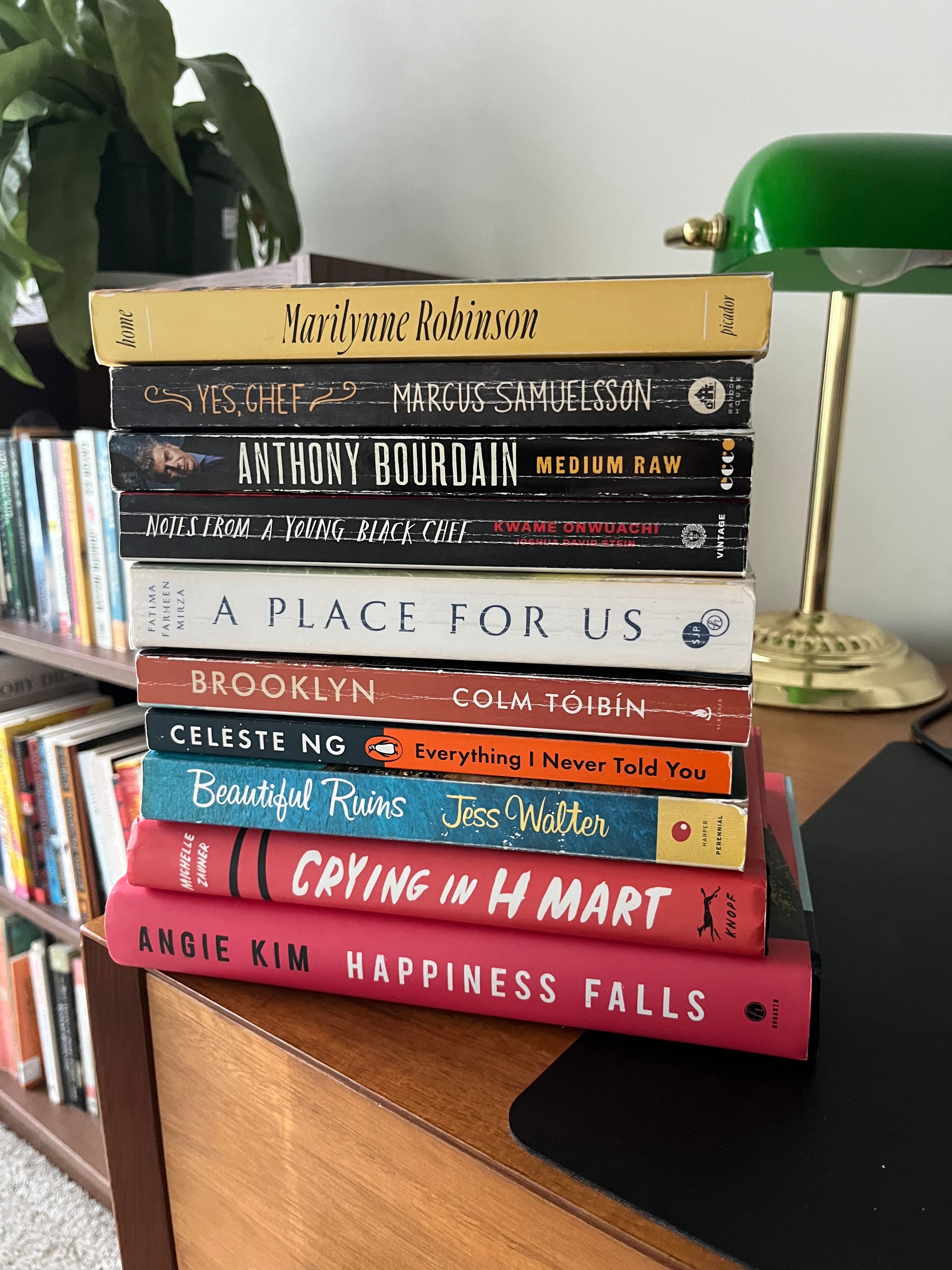
Here’s an example of what this reading looked like for me and my debut novel during each stage of the process. As you can see, not every novel might scream from the outset, “This is a comp for my book!” but so many inspired the ultimate manuscript. Asterisks denote a book that I ended up comping in a query letter! (Also, this list does not include books that were terrible and taught me what not to do. Haha.)
When My Manuscript Was Merely A Twinkle In My Eye
The Vanishing Half by Brit Bennett: My agent brought up Brit Bennett as a comp so I was very glad to have read at least one of her novels.
*Counterfeit by Kirstin Chen: A good example of how I was already reading in my genre (upmarket book-club novels by Asian-American woman authors) before I even thought to start drafting.
*Less by Andrew Sean Greer: Created the template for my hero’s globetrotting journey.
Brooklyn by Colm Tóibín: I returned to this novel again and again while I drafted my manuscript. Tóibín so beautifully portrays a rather ordinary young woman forced into a world much bigger than she asked for or expected. Brilliant, brilliant, brilliant.
*Crying in H-Mart by Michelle Zauner: Shows you I already loved food narratives even before I started writing!
God Save the Girls by Kelsey McKinney and Revival Season by Monica West: Two early books I read, long before drafting, that also depicted young women grappling with their evangelical faith.
During Drafting
Here After by Amy Lin: My novel follows a young girl dealing with the accidental death of her older brother, a chef. I wanted my novel to capture the different ways that people might grieve, so sought out this memoir for Lin’s beautiful, raw depiction.
*A Place for Us by Fatima Farheen Mirza: One of the absolute best novels I’ve read about a family grappling with identity and religion. I sobbed at the end. This book directly led to the realization that the parents in my manuscript lacked sufficient individual arcs and dimension.
*River East, River West by Aube Rey Lescure: I will always read a big upmarket book written by an Asian-American author, especially one that grapples with questions of family and identity. And because my novel is aimed at adults, I wanted to know: how did Lescure write a teenage girl main character without her book feeling too YA? This novel ended up being a comp for me!
*Miracle Creek and Happiness Falls by Angie Kim: Another beautiful depiction of an Asian-American family. Also, Angie Kim is a former lawyer, so I had to read it.
*Everything I Never Told You by Celeste Ng: This novel was so, so helpful for me as I wrote my own three-dimensional Asian-American family dealing with grief. I comped this novel, but agents and interested editors also brought it up independently. Imagine if I hadn’t read it! I would have looked like such a dummy!
Frankie and Johnny in the Claire De Lune by Terrence McNally and At Home At the Zoo by Edward Albee: There’s a scene in my novel that takes place at a play, so I read these plays as background research.
Sous Chef: 24 Hours on the Line by Michael Gibney, Yes, Chef by Marcus Samuelsson, Your Table is Ready: Tales of a New York City Maître D’ by Michael Cecchi-Azzolina, Notes From a Young Black Chef by Kwame Onwuachi, Medium Raw by Anthony Bourdain, Love, Loss, and What We Ate by Padma Lakshmi: Kitchens! Food! Essential nonfiction research!
Enter Ghost by Isabella Hammad: Enter Ghost has a play scene. I had a play scene! Hammad also writes wonderful naturalistic dialogue, which taught me a lot.
Olympus, Texas by Stacey Swann: I’ll read any big-book-club dysfunctional-family novel! Also written in third-person present, like my manuscript.
Beautiful Ruins by Jess Walter: Taught me a lot about how to write about an industry glamorous to outsiders (Hollywood for Walter, culinary world for me) and how to use interstitials in the text.
Tomorrow, Tomorrow, and Tomorrow by Gabrielle Zevin: I dreamt of my book hitting the same niche as this book did.
Preparing for Querying
Service by Sarah Gilmartin: My novel is set in the thrilling world of high-end kitchens, so I of course wanted to read any new books set in the world of restaurants.
Beautyland by Marie-Helene Bertino: My novel is written in third-person present tense, so I actively sought out books written in the same. Marie-Helene is so brilliant with language, and her word choice inspired me as I refined my sentences before sending to agents. Also, her novel begins with an odd duckling of a young girl, yet it never feels like a YA novel—I wanted to know how she did it!
All The World Beside by Garrard Conley: My book grapples with questions of faith and identity, so I read any book doing the same. (Garrard was actually the Fellow for my Bread Loaf workshop, so I read a copy he signed for me—he’s brilliant.)
During Revisions
My Brilliant Friend and Those Who Leave and Those Who Stay by Elena Ferrante: I am working to improve my depictions of interiority, and Ferrante is brilliant at that. She also writes such wonderful, complicated young girls and women—and a complicated eighteen-year-old girl is at the center of my debut.
Homeseeking by Karissa Chen: Big upmarket book, Asian-American author, questions of family and identity.
Anyway—all this is to show that comps can show up in unexpected ways, but only if you’re reading first. And anyway, why wouldn’t you want to make your manuscript better? Why wouldn’t you read?
Ten conventional and unconventional tips to read more, even if you’re busy
Bring a book everywhere you go, so that you don’t have to stare at your phone the next time you’re waiting in line.
Leave a book in your car.
Take your lunch break (don’t eat through work like me!) and read.
Practice good sleep hygiene and read for fifteen to thirty minutes before bed instead of gazing into the void of your phone’s blue light.
If your book is too heavy to read on your commute, be a psycho like me and slice it up into smaller sections.
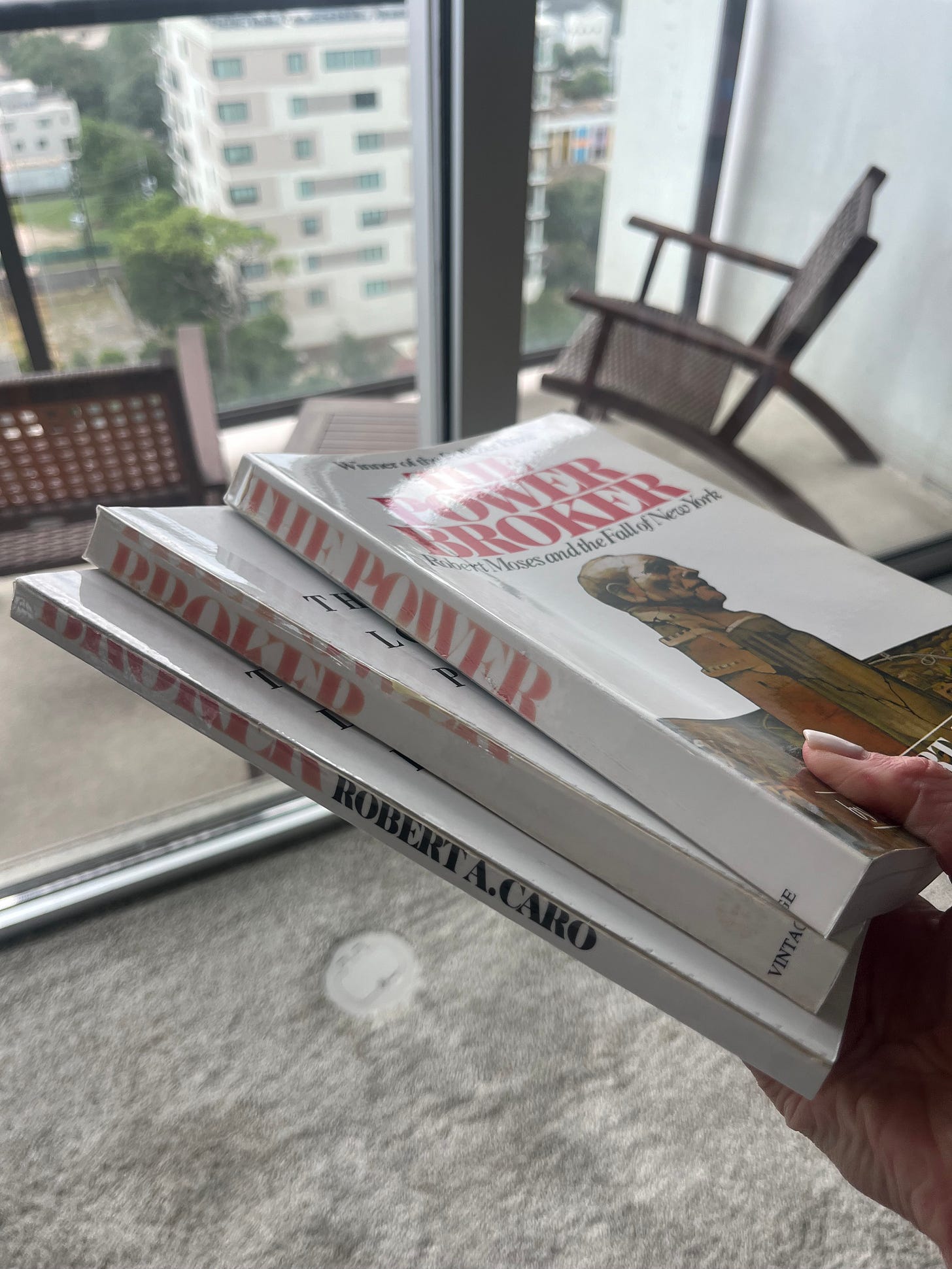
I sliced The Power Broker into thirds to make it easier to read on the subway. Many said I was a sicko for this but guess how many of those people finished reading The Power Broker? Comment if you want my advice on where to slice it. If you have a short attention span or end up having to take long breaks in between reading sessions due to life or work, try a short story collection. My recent favorites are Interpreter of Maladies by Jhumpa Lahiri, Music for Wartime by Rebecca Makkai, and Extinction Capital of the World by Mariah Rigg. My fiancé loves Redeployment by Phil Klay.
Read novellas! Who cares that they’re short! Here’s one of my favorite novellas under 100 pages: Down the Rabbit Hole by Juan Pablo Villalobos. Here’s two of my favorite novellas under 200 pages: Bonjour Tristesse by Françoise Sagan and Hadji Murat by Leo Tolstoy.
Read plays! Who cares that they’re short! Recent faves of mine include The Strange Undoing of Prudencia Hart by David Grieg and anything by Suzan Lori-Parks.
Read poetry collections! Who cares that they’re short! My fiancé is currently obsessed with Christian Wiman’s poetry.
Print out short stories on your office printer and take them home to read. “Boss makes a dollar, I make a dime, that’s why I print New Yorker fiction on company time!” Even better, if you print them in Times New Roman, it will just look like you’re doing work! [Disclaimer: This tip is not a concession that I have ever used my employer’s resources in such a manner.]

Sincerely,
Nina